
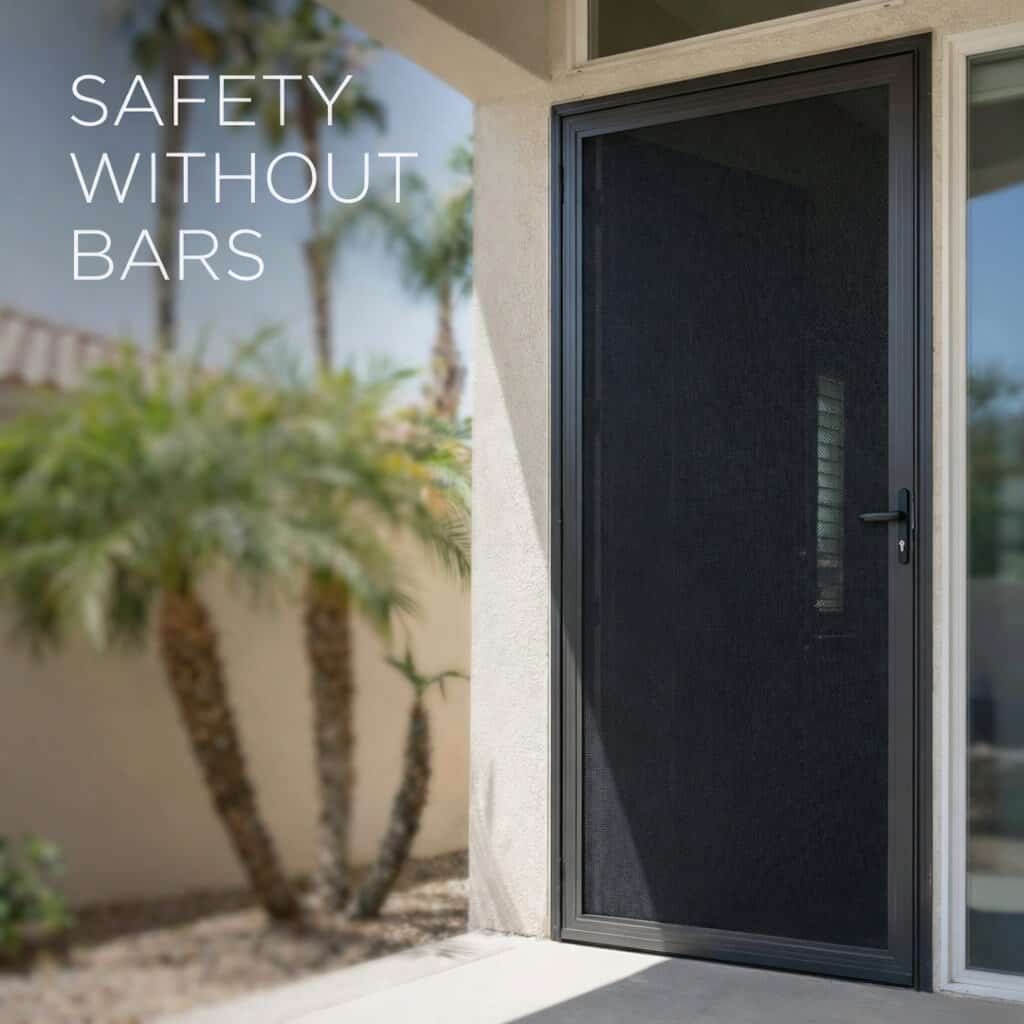
Modern security doors in Los Angeles address a persistent challenge: the city reported 14,248 burglaries in 2024, and front doors remain the primary entry point for intruders in 34% of break-ins (Valley Alarm). Traditional wrought iron security bars offer physical protection but transform homes into fortress-like structures that damage curb appeal, reduce natural light, and can trap occupants during fires.
Security screen doors—marketed as "invisible" security—resolve this tension by using high-tensile stainless steel mesh that appears transparent from inside while resisting cutting, prying, and impact forces exceeding 500 Joules. These systems preserve architectural aesthetics, allow fresh air and natural ventilation while keeping out bugs and other pests, and meet California fire egress requirements. They provide peace of mind for families while maintaining property values, making them the preferred alternative for homeowners in gentrifying neighborhoods from Highland Park to Mar Vista and coastal communities requiring marine-grade corrosion resistance.
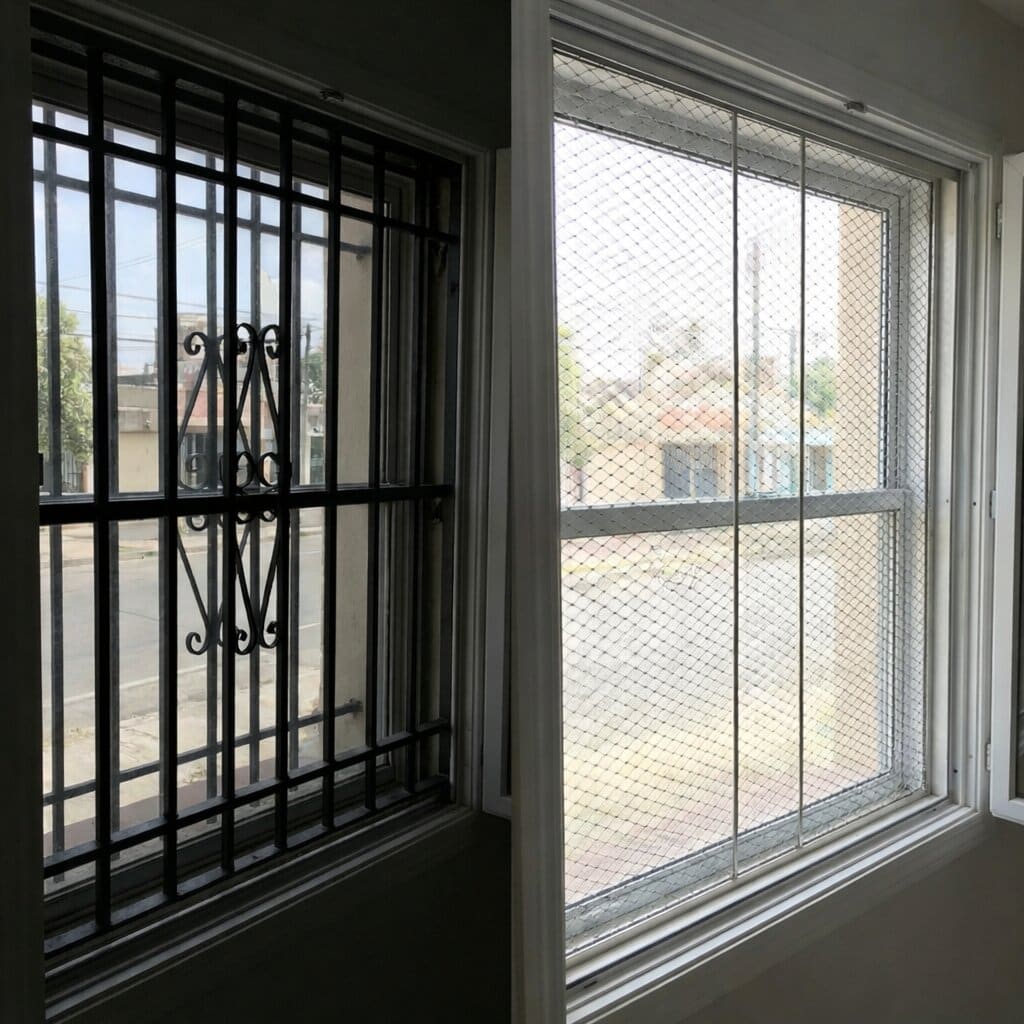
The wrought iron security bars that defined Los Angeles streetscapes from the 1980s through early 2000s created an architectural paradox: they protected homes while simultaneously diminishing their value and livability.
Fixed iron bars signal "high-crime neighborhood" to prospective buyers, regardless of current safety conditions. In rapidly gentrifying areas like West Adams and Echo Park, real estate agents consistently note that bars must be removed before listing—a property with visible security bars can face price reductions or extended time on market as buyers interpret them as warnings rather than assets.
The bars create visual clutter that obscures the architectural details Venice bungalows and Spanish Colonial homes that command premium prices in Los Angeles. Your home's appearance directly impacts market valuation and prevents creating an elegant first impression for visitors and potential buyers. Modern appraisers increasingly factor "defensive architecture" as a negative attribute, particularly in neighborhoods where security concerns have decreased but the bars remain as relics of past conditions.
California Building Code Section 1031.2.1 mandates that all security barriers on bedroom windows and emergency escape openings must be openable from inside without keys, tools, or special knowledge (County of Los Angeles Security Requirements, 2021). Many older bar installations lack compliant quick-release mechanisms, creating death traps during residential fires.
Fixed bars that require exterior padlocks or Allen wrenches trap occupants attempting to escape smoke and flames. The Los Angeles Fire Department regularly encounters situations where firefighters must cut through non-compliant bars to reach victims, adding critical minutes to rescue operations and delaying access to people in distress.
In contrast, modern security screens function as standard doors with internal latches, allowing instant egress while maintaining external security and preventing unlawful entry from outside. The unlatching requires no more than one operation—typically a single lever or handle—satisfying both security needs and life-safety codes (County of LA Security Requirements, 2021).
Security screen doors represent a convergence of materials science and mechanical engineering, transforming what appears to be a standard insect screen into a secure barrier capable of withstanding sustained attack. The technology relies on three integrated systems: high-tensile stainless steel mesh, tamper-resistant retention mechanisms, and multi-point locking systems designed specifically for residential defense.
Unlike decorative wrought iron, which depends on visual deterrence, security screens are engineered to physically deny entry through material strength and structural redundancy, ensuring maximum security for your family.
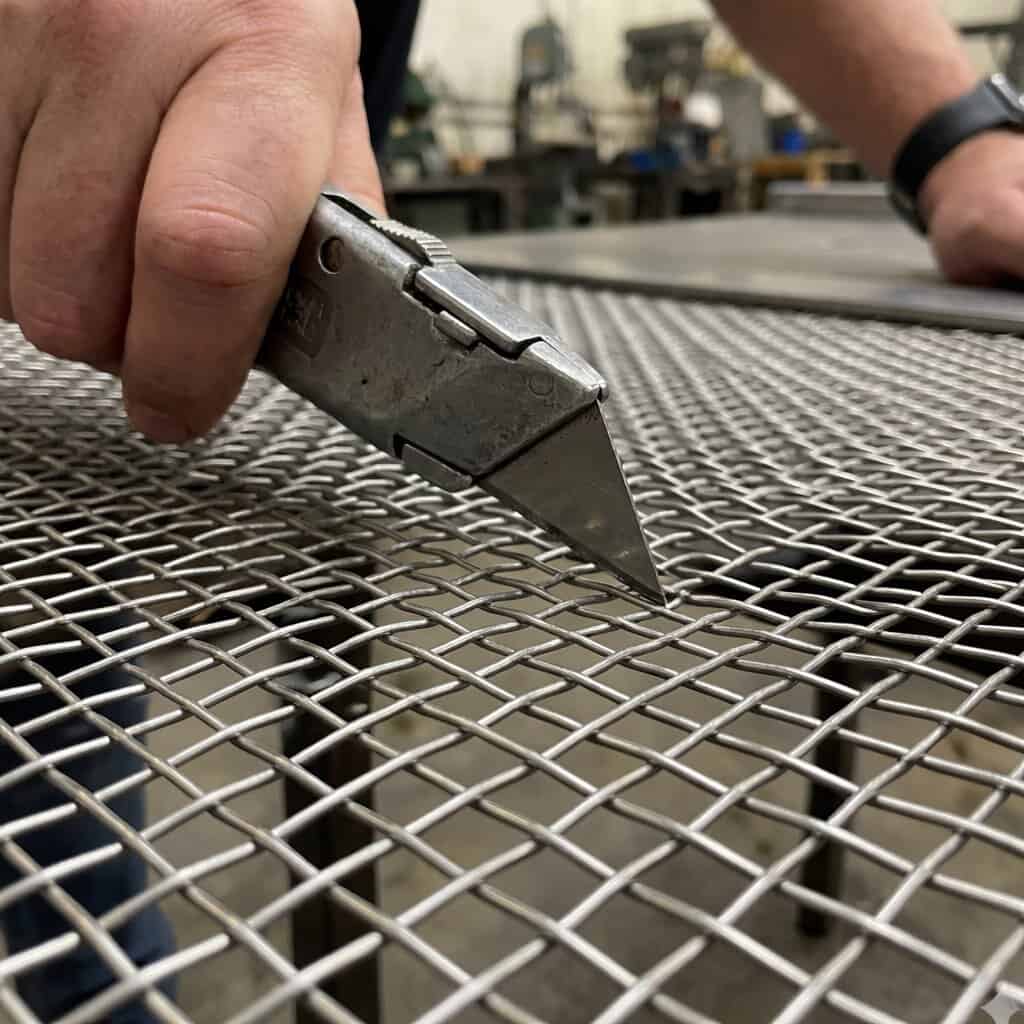
Standard insect screens use soft aluminum wire (0.011" diameter) or fiberglass mesh that a pocket knife cuts instantly. Security-rated screens employ US-woven stainless steel mesh with wire diameters of 0.035" to 0.04"—more than three times thicker—woven into an 11×11 or 12×12 strand-per-inch grid.
The Australian Standard AS 5041-2003 specifies the "knife shear test," in which a heavy-duty trimming knife is dragged along the mesh with a vertical force of 150 Newtons (approximately 33 pounds) and horizontal force of 350 Newtons (76 pounds), repeated three times along the same line (AS 5041-2003). Standard window screens fail instantly; high-tensile 304-grade stainless steel passes without penetration due to the hardness of the steel wire resisting the shearing action.
The mesh must also survive dynamic impact testing to provide true protection. A standardized impactor (sandbag or lead shot bag) weighing 40-50 kilograms is swung as a pendulum against the screen. Basic standards require withstanding five impacts of 100 Joules each, but premium brands like Crimsafe test to 500-750 Joules—roughly equivalent to a 200-pound person kicking the door with full force.
The woven structure distributes impact energy across the entire mesh rather than concentrating it at a single failure point. This allows the screen to absorb and dissipate forces that would shatter glass or bend aluminum bars.
304-grade stainless steel (18% chromium, 8% nickel) provides tensile strength often exceeding 800 MPa while maintaining sufficient ductility to absorb impact without brittle fracture. This alloy performs well in inland Los Angeles environments—Pasadena, San Fernando Valley, Downtown—where atmospheric salinity is minimal. However, coastal environments present different durability requirements.
Traditional residential doors rely on a single latch and deadbolt at mid-height, creating a concentrated stress point vulnerable to crowbar attacks. A determined intruder can insert a pry bar between the door and frame near the lock, applying leverage to bend the frame or snap the bolt.
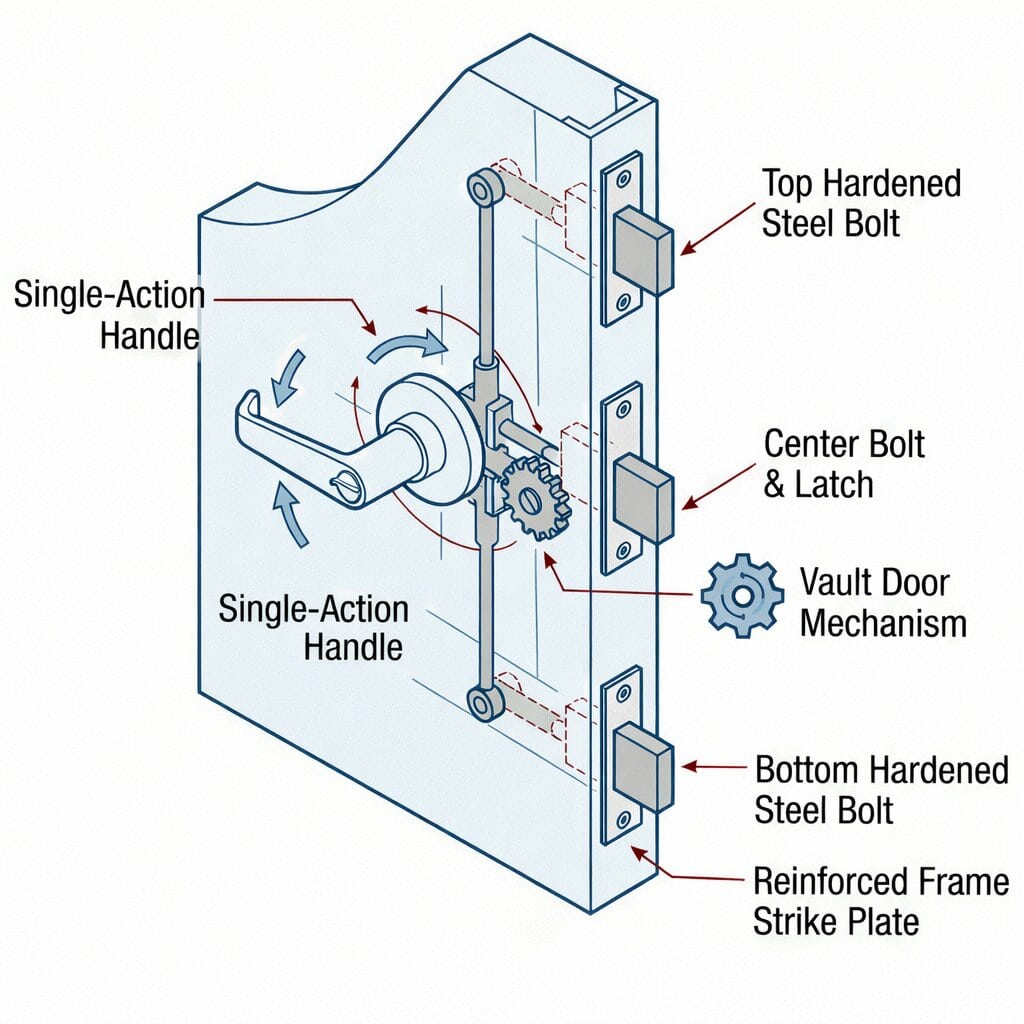
Security screen doors universally feature three-point locking mechanisms that engage the door at top, center, and bottom via a single handle operation—similar to gun safe door mechanisms, hence the "vault door" marketing terminology. This provides true protection against forced entry attempts.
When the handle is activated, hardened steel bolts simultaneously extend into strike plates anchored to the door frame at three separate locations. If an intruder applies a crowbar to the center lock, the top and bottom bolts remain engaged, dissipating the leverage force across the entire frame height rather than concentrating it at a single point.
The frame itself features overlapping lips (jemmy guards) that prevent the insertion of a pry bar in the first place. The lock cylinders are recessed within reinforced frame channels, protected by internal plates that prevent drilling or manipulation, ensuring maximum security.
The locking system is only as strong as its anchor points. Professional installation requires screwing the security door frame into the building's structural studs (sub-frame) using 3.5" to 4" hardened screws placed every 8 to 12 inches—not just into the decorative trim. Since most US homes lack factory-installed security screen mounting points, installers create "build-out" frames or "Z-frames" that adapt the security door to existing casings while ensuring anchor points hit solid wood framing members.
Without proper structural anchoring, even the strongest mesh and locks can be defeated by ripping the entire frame out of the wall.
Los Angeles County's geographic diversity—spanning 75 miles of coastline and extending inland through multiple climate zones—creates distinct regional requirements for security screen specifications.
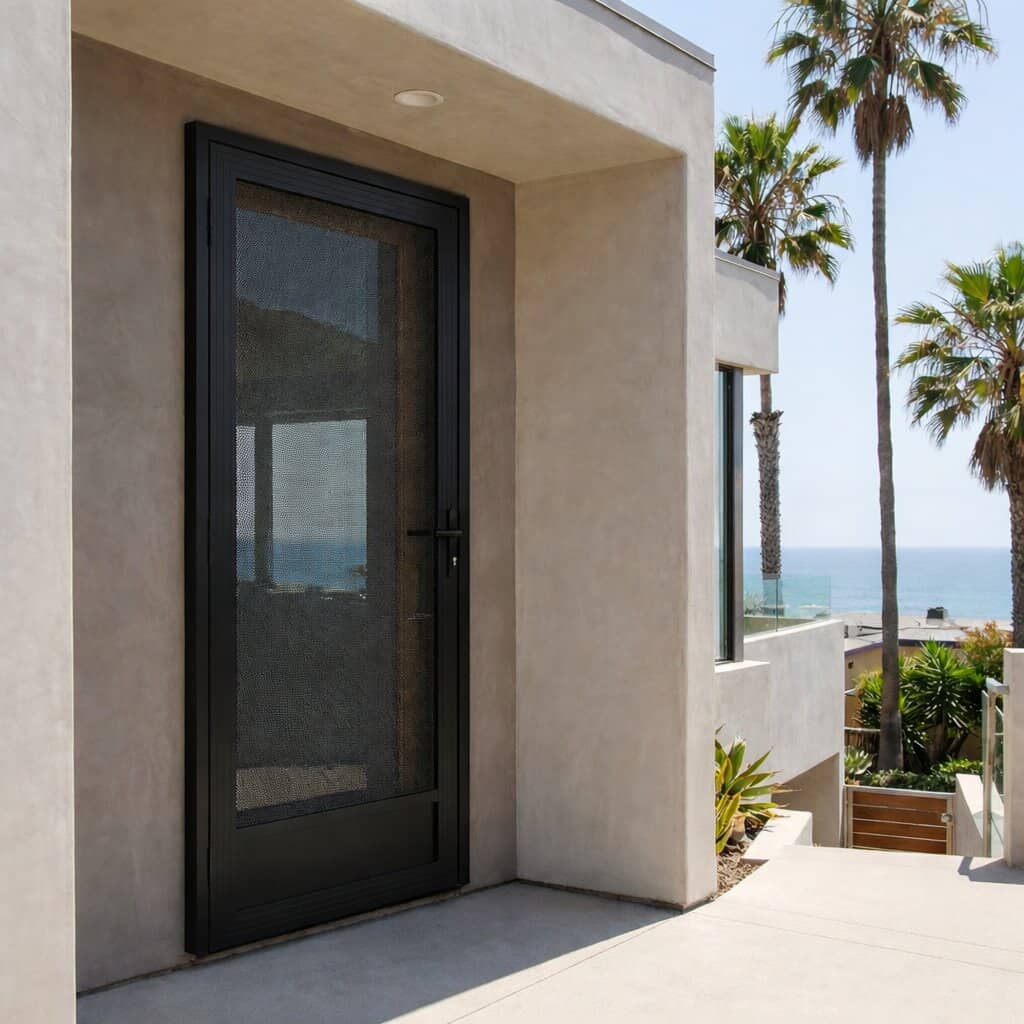
Properties within approximately 5 miles of the Pacific Ocean require 316 marine-grade stainless steel mesh rather than standard 304-grade material. While both alloys offer comparable tensile strength, 316-grade adds 2-3% molybdenum, which dramatically enhances resistance to pitting and crevice corrosion caused by chloride environments (salt spray).
In Santa Monica and Venice, atmospheric salt concentrations accelerate oxidation of standard 304-grade mesh, creating "tea staining" (superficial rust discoloration) and eventual structural weakening within 3-5 years without intensive maintenance.
Manufacturers subject 316-grade screens to salt spray testing per ASTM B117 or AS 2331 standards, often exceeding 1,000 to 3,000 hours of continuous saline mist exposure. A pass rating means no blistering of the powder coat and no structural corrosion of the mesh.
Ocean-view properties in Malibu, Pacific Palisades, and the South Bay pay premium pricing for 316-grade specifications—typically 15-20% more than 304-grade—but the investment prevents catastrophic corrosion failure and eliminates the annual maintenance cycle of sanding and repainting required for traditional iron bars in coastal zones. The enhanced durability also provides protection against flying debris during high-wind events common along the coast.
A critical engineering consideration in marine environments: galvanic corrosion. Security screens pair stainless steel mesh with extruded aluminum frames (Alloy 6063-T5 or T6). When dissimilar metals contact each other in the presence of an electrolyte (saltwater), a galvanic cell forms, rapidly destroying the aluminum.
Premium manufacturers insert a PVC or rubber isolation membrane between the mesh and frame to prevent direct metal-to-metal contact. This extends the system's lifespan from 5-7 years to 15-20 years in coastal installations.
At Peninsula Mobile Screens, we’ve specialized in these coastal-grade installations since 1999, ensuring that security doors in Los Angeles are built to withstand the unique salinity of our beachside communities.
Los Angeles Historic Preservation Overlay Zones (HPOZs) in neighborhoods like West Adams, Jefferson Park, and Highland Park impose strict regulations on exterior modifications to preserve architectural character. Traditional wrought iron bars are frequently rejected by HPOZ boards as historically inappropriate or visually incongruent with Craftsman, Spanish Colonial Revival, or Mid-Century Modern homes.
The administrative review process can extend 3-6 months, and rejections are common for security modifications that alter the home's silhouette or interrupt the "rhythm of the streetscape."
Security screens bypass these restrictions through optical physics and design flexibility. Black powder-coated mesh exploits the principle of light absorption versus reflection: viewed from inside during daylight, the mesh appears transparent because ambient interior light is darker than exterior light passing through the screen.
From the street, the mesh appears opaque or blends with shadowed door recesses, creating the "invisible" effect. By mounting the screen inside the door jamb rather than as a surface-mounted grille, and by matching the frame powder-coat color to existing trim (Bronze, Sandstone, Black, White, or custom matches), the security measure recedes visually while preserving unobstructed views and architectural proportions.
Gentrifying neighborhoods like Highland Park present a unique market dynamic. Long-term residents ("veteranos") often retain legacy iron bars as pragmatic responses to historical crime patterns, while new homeowners prioritize the clean, bar-free aesthetic required to maximize property values.
Security screens allow both cohorts to achieve their objectives. Established residents can replace non-compliant bars with code-conforming protection, while new buyers can install robust security without signaling "fortress mentality" to prospective resale purchasers.
Real estate listings in transitioning neighborhoods increasingly feature "security screens" as premium upgrades rather than defensive necessities. This repositions the technology as a modern amenity analogous to smart thermostats or high-efficiency windows.
Security screen manufacturers operate on a measure-manufacture-install model because dimensional precision is critical to performance. Gaps of even a few millimeters between the frame and door opening create leverage points exploitable by pry bars.
An expert team of installers uses laser measurements to ensure custom-fabricated frames fit openings within tight tolerances—typically ±1/8 inch. Every Los Angeles home has settled differently over decades, particularly in older construction where wood framing has warped or foundations have shifted slightly. Off-the-shelf sizing cannot accommodate these variations.
The consultation phase assesses the structural integrity of existing door jambs. If the wood is rotted from water exposure or termite damage, or if the framing is undersized (common in pre-1960s construction), it must be reinforced before the security screen can be installed.
A screen anchored to compromised framing provides false security—the entire assembly can be kicked in despite the mesh's strength. Contractors typically install sister studs or steel reinforcement plates to create a solid anchor substrate, ensuring a perfect fit that integrates with the home's existing structure.
Customization extends beyond dimensions to aesthetic integration. Each screen is crafted to match the home's existing trim colors through powder-coating of the aluminum frames, allowing the screen to visually disappear. For Spanish Colonial homes with wrought iron decorative elements, some manufacturers offer perforated or decorative mesh inserts that echo the historical grillework pattern while maintaining the structural security of the underlying high-tensile mesh.
For modern minimalist architecture in Culver City or Silver Lake, frameless or ultra-thin frame profiles minimize visual interruption. Retractable screen options exist for homeowners who want the security barrier deployable only when needed (overnight or during extended absences), though retractable mechanisms sacrifice some structural strength compared to fixed installations.
Professional installation typically requires 3-6 hours for a standard hinged entry door, with sliding patio doors (which require larger mesh panels and more complex track systems) extending to 6-8 hours. All exterior screws are either concealed within frame channels or use tamper-proof heads (one-way screws that can be driven in but not reversed with standard tools), preventing an intruder from simply removing the screws to detach the screen.
| Feature | Traditional Iron "Burglar Bars" | Invisible Security Screens |
|---|---|---|
| Visibility | Blocks views; creates "prison" aesthetic | Clear view from inside; mesh appears transparent |
| Airflow | Partial—allows passage but collects debris | Full ventilation with insect protection; keeps out bugs and pests |
| Tool Resistance | Vulnerable to hydraulic jacks, reciprocating saws, angle grinders | Resists knife attacks (350N), impacts (500-750J), prying (450N leverage) |
| Emergency Exit | Often non-compliant; requires keys/tools to open | Internal quick-release; single-operation egress per CBC 1031.2.1 |
| Maintenance | Prone to rust; requires annual sanding/repainting | Corrosion-resistant (316 marine-grade in coastal zones); wash-down cleaning only |
| Property Value Impact | Can decrease value by signaling "high-crime" perception | Marketed as premium upgrade; maintains or increases value |
| Regulatory Compliance | Older installations frequently violate fire egress codes | Engineered for CBC compliance; HPOZ-approvable in most cases |
| Cost (per opening) | $200-$500 (materials + basic installation) | $1,000-$3,000+ (professional installation, custom fabrication) |
| Lifespan | 10-15 years with maintenance; coastal environments 5-8 years | 15-20 years (316-grade coastal installations); 10-15 years (304-grade inland) |
Ready to upgrade from traditional iron bars to "invisible" security? Peninsula Mobile Screens has been the trusted local expert for security doors in Los Angeles since 1999.
Get a free estimate today to see how we can match your home’s architectural DNA with modern protection.
Security screen doors comply with California Building Code Section 1031.2.1 by incorporating internal release mechanisms that allow occupants to exit without keys, tools, or special knowledge (County of Los Angeles Security Requirements, 2021). The unlatching operation requires no more than a single lever or handle movement—typically identical to operating a standard deadbolt from inside.
Unlike fixed iron bars, which trap occupants during fires unless equipped with quick-release padlocks (often rusted or inaccessible during emergencies), security screens function as operable doors. The screens open outward or slide aside on tracks, providing full egress clearance and immediate access to escape routes.
This design satisfies both the Building Code's life-safety requirements and homeowners' security needs, eliminating the compliance violations common in legacy bar installations.
The United States lacks a unified federal testing standard for residential security screens, so the industry relies on Australian Standards AS 5039 and AS 5041-2003, which manufacturers license for US product validation (AS 5041-2003). These protocols include:
Knife Shear Test (AS 5041): A heavy-duty trimming knife is dragged along the mesh with vertical force of 150N and horizontal force of 350N, repeated three times. The mesh must not be penetrated in a continuous line exceeding 150mm.
Dynamic Impact Test: A standardized impactor (40-50kg sandbag) is swung as a pendulum against the screen. Basic standard requires withstanding five impacts of 100 Joules each; premium brands test to 500-750 Joules or higher.
Jemmy Test (Leverage Attack): A crowbar is inserted between door and frame at all locking points and hinges. Torque force is applied to attempt prying the door open. The door must remain securely locked and cannot be pried open beyond a specified gap width.
Salt Spray Test (AS 2331, ASTM B117): The assembly is placed in a chamber and exposed to continuous saline mist. Standard testing ranges from 240 hours to 3,000 hours for marine-grade claims. Pass criteria: no blistering of powder coat and no structural corrosion of mesh.
While these are rigorous benchmarks, they remain voluntary in the US market. Manufacturers who market based on test results typically provide certification documentation, but enforcement is consumer-driven rather than regulatory-mandated.
California building inspectors verify code compliance for fire egress but do not independently test claimed impact resistance.
304-grade stainless steel (18% chromium, 8% nickel) is the most common commercial stainless alloy, offering excellent tensile strength (typically 800+ MPa) and general corrosion resistance. It performs well in inland Los Angeles environments (Pasadena, San Fernando Valley, Downtown) where atmospheric salinity is low.
However, 304-grade is susceptible to "tea staining" (superficial corrosion) and eventual pitting in high-salt coastal environments without intensive maintenance.
316 marine-grade stainless steel adds 2-3% molybdenum to the 304 composition. Molybdenum dramatically enhances resistance to pitting and crevice corrosion caused by chloride environments (salt spray).
For properties within approximately 5 miles of the Pacific Ocean—Santa Monica, Venice, Malibu, Manhattan Beach, Redondo Beach—316-grade is considered the minimum specification for structural longevity and durability. Manufacturers subject 316-grade mesh to salt spray testing (ASTM B117 or AS 2331) often exceeding 1,000 to 3,000 hours of continuous saline mist exposure.
The cost premium for 316-grade material ranges from 15-25% above 304-grade pricing. In coastal installations, this investment prevents catastrophic corrosion failure and eliminates the annual maintenance cycle required for traditional iron bars.
Both alloys offer comparable tensile strength and impact resistance; the primary differentiator is long-term corrosion performance in marine environments.
High-quality 316 marine-grade stainless steel screens in coastal Los Angeles environments (Santa Monica, Venice, Marina del Rey, Malibu) typically last 15-20 years with routine maintenance, which consists primarily of washing down with fresh water to remove accumulated salt and debris.
The powder-coated aluminum frames resist corrosion when properly manufactured with galvanic isolation (PVC or rubber membrane separating the stainless steel mesh from the aluminum frame to prevent electrochemical reactions).
Standard 304-grade screens installed in coastal zones typically show corrosion signs (tea staining, pitting) within 3-5 years and may require replacement or intensive restoration at 7-10 years. The performance gap between grades widens significantly in direct salt-spray exposure (properties within 500 feet of the ocean) versus those 2-5 miles inland where atmospheric salinity is lower but still present.
For comparison, traditional wrought iron bars in coastal environments require annual sanding and repainting to prevent structural rust, and even with maintenance typically fail at 10-12 years as corrosion weakens weld joints and mounting brackets.
The higher upfront cost of 316-grade security screens is offset by reduced maintenance labor and longer replacement intervals.
Security screen manufacturers offer extensive customization to integrate with diverse architectural styles prevalent across Los Angeles:
Frame Colors: Powder-coating in Bronze, Sandstone, Black, White, and custom color-matches to existing trim allows the frame to visually disappear against the home's facade. Powder-coating also provides the corrosion-resistant finish necessary for outdoor exposure.
Mesh Patterns: While high-tensile 11×11 or 12×12 woven mesh is standard, some manufacturers offer perforated or decorative mesh inserts that echo historical grillework patterns for Spanish Colonial or Mediterranean Revival homes. These maintain the structural security of the underlying woven mesh while adding period-appropriate visual elements.
Door Styles: Security screens and security window screens are available for hinged entry doors, sliding patio doors (including multi-panel sliders up to 12 feet wide), French doors (in-swing and out-swing), bifold systems, and stacking door configurations.
Retractable screens exist for homeowners who want deployable security only when needed, though retractable mechanisms sacrifice some structural strength compared to fixed installations.
Frame Profiles: Modern minimalist homes in Culver City or Silver Lake can specify ultra-thin frame profiles or frameless designs that minimize visual interruption. Historic properties can request frames with traditional sight lines that match original door casings.
All installations are custom-measured and fabricated to precise dimensions (within ±1/8 inch tolerance) to eliminate gaps exploitable by pry bars. The customization process typically adds 2-3 weeks to lead times compared to off-the-shelf products, but dimensional precision is critical to both security performance and aesthetic integration.
Security screens provide measurable energy-efficient benefits through two mechanisms: solar heat gain reduction and enhanced natural ventilation. The stainless steel mesh acts as a passive solar shade, blocking up to 50-60% of solar heat gain while maintaining visibility and airflow.
On west-facing exposures in Los Angeles—which experience intense afternoon sun—this reduction in thermal load decreases air conditioning demand by allowing homeowners to maintain comfort without lowering thermostat settings as aggressively.
More significantly, security screens enable extended use of natural ventilation while allowing fresh air into the home. Homeowners can leave entry doors and windows open for cross-breeze cooling during temperate mornings and evenings without compromising security. This provides peace of mind for families with pets who want ventilation while safeguarding against unlawful entry.
In Los Angeles' Mediterranean climate, where overnight temperatures drop 15-25°F below daytime highs, this natural ventilation can eliminate air conditioning usage for 4-6 months annually (roughly March-May and October-November). The energy savings compound over the system's 15-20 year lifespan.
Some California utility providers and municipalities offer rebates or incentives for passive cooling measures, though security screens are not universally recognized in these programs. Homeowners should verify current incentive eligibility through programs like the Los Angeles Department of Water and Power's Energy Efficiency Rebate Program or SoCalGas's Energy Savings Assistance Program, as qualifications change periodically.
The mesh also filters up to 60% of harmful UV rays, reducing fading of interior furnishings, flooring, and artwork—a secondary benefit that preserves property value but does not directly reduce energy costs.
The knife shear test (specified in Australian Standard AS 5041-2003) simulates an intruder attempting to cut through the mesh to unlock the door from inside or create an entry point large enough to climb through (AS 5041-2003).
The test protocol applies a heavy-duty trimming knife (analogous to a utility knife or box cutter) to the mesh surface with a vertical force of 150 Newtons (approximately 33 pounds of downward pressure) and a horizontal force of 350 Newtons (76 pounds of lateral cutting force). The knife is dragged along the same line three times consecutively.
To pass, the mesh must not be penetrated in a continuous line exceeding 150mm (approximately 6 inches). Standard fiberglass or soft aluminum insect screens fail this test instantly—a single pass with moderate pressure cuts clean through.
High-tensile 304 or 316-grade stainless steel mesh with wire diameters of 0.035" to 0.040" resists the shearing action because the hardened steel wire exceeds the yield strength of the knife blade. The cutting tool dulls or skips across the mesh surface rather than severing the wires.
This test matters because readily available cutting tools—box cutters, pocket knives, kitchen knives—are common burglary implements. A burglar can carry a knife without attracting attention, unlike bolt cutters or reciprocating saws which signal criminal intent.
If the mesh can be cut silently with a pocket tool, the security system fails regardless of the lock's strength. The knife shear test validates that the mesh itself is a functional barrier, not just a visual deterrent that can be easily circumvented.
Traditional residential doors use a single latch and deadbolt at mid-height, creating a concentrated stress point vulnerable to leverage attacks. A crowbar inserted between the door and frame near the lock can bend the frame or snap the bolt through concentrated force application—a technique requiring only 10-15 seconds for a practiced intruder.
Three-point locking systems distribute engagement across the door's height, ensuring maximum security. When the handle is activated, hardened steel bolts simultaneously extend into strike plates at three locations: top (typically 6-8 inches from the top edge), center (standard latch height), and bottom (6-8 inches from the bottom edge).
If a crowbar is applied to the center lock, the top and bottom bolts remain engaged, dissipating the leverage force across the entire frame height rather than concentrating it at a single failure point.
The system's effectiveness relies on three factors:
Force Distribution: With three engagement points, leverage force must overcome three separate bolt-and-strike assemblies simultaneously. The mechanical advantage gained by a crowbar is divided across multiple points, requiring exponentially more force than defeating a single lock.
Frame Reinforcement: The aluminum frame includes overlapping lips (jemmy guards) that prevent insertion of a crowbar between the door and frame. The gap is eliminated or reduced to less than 1/4 inch, preventing tool insertion.
Structural Anchoring: The frame is anchored into the building's structural studs with 3.5" to 4" hardened screws every 8-12 inches—not just into decorative trim. This creates a rigid assembly that transfers impact forces into the wall framing rather than allowing the frame to flex or detach.
Australian Standard AS 5041 tests three-point locks by applying lever force at all locking points and hinge locations. The door must remain securely locked and cannot be pried open beyond a specified gap width.
While individual lock strength matters, the distribution of locking points across the door height is the critical security differentiator from traditional single-point deadbolts.
This information is provided for general awareness regarding home security options. For emergencies, contact local emergency services. Building codes, fire safety regulations, and HPOZ requirements vary by jurisdiction within Los Angeles County and change over time.
Verify current requirements with the Los Angeles Department of Building and Safety, local fire authorities, and relevant Historic Preservation offices before purchasing or installing security systems. This content does not constitute professional advice on compliance, installation, or product selection. Consult licensed contractors and building officials for guidance specific to your property and situation.
This article was authored by the Peninsula Mobile Screens team, a family-run business serving the Greater Los Angeles area since 1999. The content draws directly from over two decades of experience in mobile screen services and reflects the company’s own history and growth journey.
